

Mud-Terrain vs Rugged-Terrain vs All-Terrain: Choosing the Right Aggression Level
Posted by BB Wheels on 23rd Dec 2025
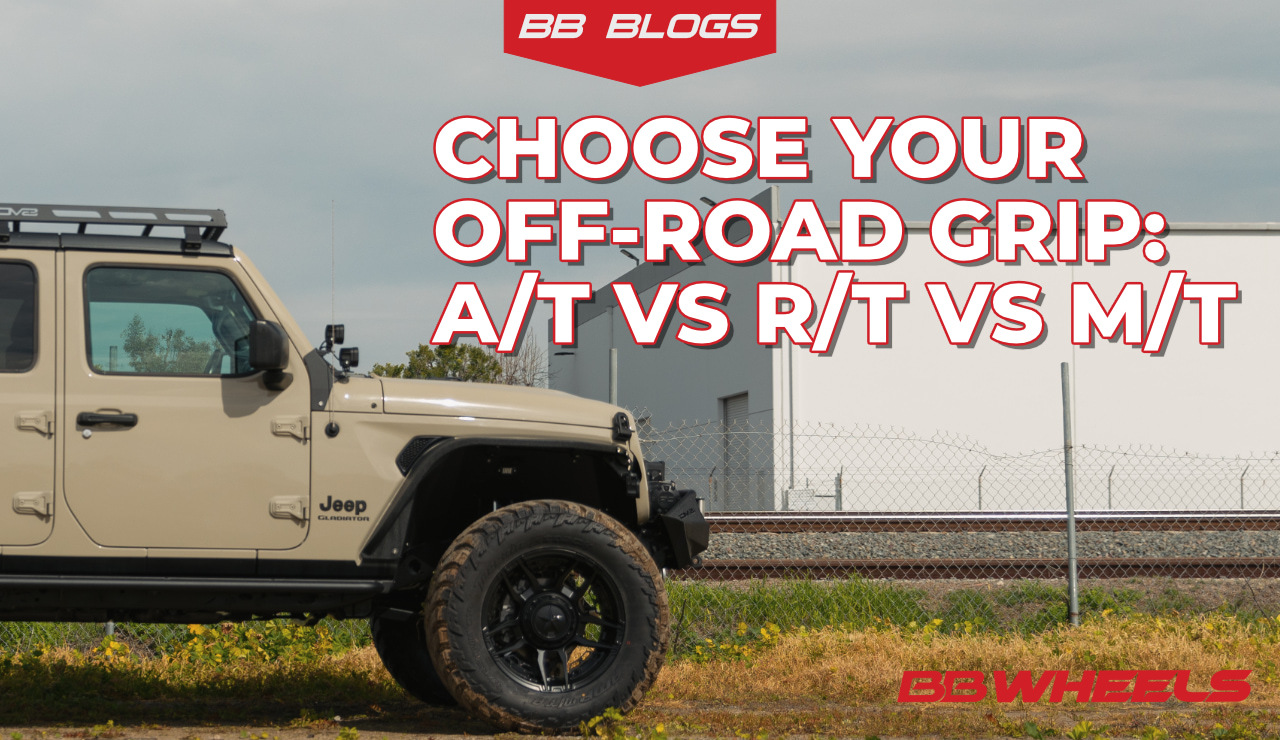
Mud-Terrain vs Rugged-Terrain vs All-Terrain: Choosing the Right Aggression Level
Picking off-road tires isn’t just about looks—it’s about matching your tread to how you actually drive. Go too mild and you’ll spin in the sloppy stuff. Go too aggressive and you’ll live with extra noise, weight, and wear you didn’t need.
That’s where the big three come in: All-Terrain (A/T), Rugged-Terrain (R/T), and Mud-Terrain (M/T). Think of them as an aggression ladder: A/T for balanced daily driving, R/T for serious mixed-use, and M/T for maximum bite in mud and loose terrain.
This guide breaks down the differences in plain language so you can pick the right level of traction for your truck or SUV.
- What A/T, R/T, and M/T tires are built for
- How they differ in traction, noise, wear, and road manners
- Which type makes the most sense for your driving
- What to look for before you buy (load range, 3PMSF, sizing, and more)
Quick Snapshot: A/T vs R/T vs M/T
- All-Terrain (A/T): Best all-around choice for daily driving with real off-road capability.
- Rugged-Terrain (R/T): A more aggressive hybrid built for frequent trail use while staying livable on-road.
- Mud-Terrain (M/T): Maximum off-road bite, especially in mud, ruts, and loose terrain—with more tradeoffs on pavement.
What Is an All-Terrain Tire (A/T)?
All-terrain tires are the everyday workhorse for trucks and SUVs. They’re designed to handle highway miles comfortably while still giving you confident traction on gravel roads, dirt, light mud, and trails.
A/T strengths
- Comfortable on-road (generally quieter and smoother)
- Versatile traction for mixed driving
- Better tread life compared to more aggressive categories (in many cases)
- Great for daily-driven trucks that still see weekends outdoors
A/T tradeoffs
- Less “self-cleaning” in deep mud than R/T or M/T
- May pack up sooner in sticky clay or deep ruts
- Not the first pick for dedicated mud or rock use
Who A/T is for: The driver who spends most of their time on pavement but wants a tire that won’t fold when the road turns to gravel, dirt, or light trail.
What Is a Rugged-Terrain Tire (R/T)?
Rugged-terrain tires (often called hybrids) are built for drivers who want more aggression than an A/T without committing to the full on-road compromise of an M/T. They typically run deeper tread, chunkier shoulder lugs, and tougher construction than many all-terrains.
You can think of R/T as the “middle gear”: more off-road traction than A/T, less noise and harshness than many M/T setups.
R/T strengths
- Stronger off-road bite than A/T (especially in loose dirt, sand, and rutted terrain)
- Better self-cleaning than most A/T tires
- More aggressive look with beefy shoulders
- Solid option for frequent trail use while still being road-friendly
R/T tradeoffs
- Often louder than A/T
- Usually heavier, which can affect ride and efficiency
- Tread life and winter performance can vary widely by model
Who R/T is for: The driver who hits trails regularly, deals with rough terrain often, or wants a tougher tire than an A/T—but still racks up street miles.
What Is a Mud-Terrain Tire (M/T)?
Mud-terrain tires are designed for maximum traction in the nastiest conditions. Big tread blocks, wide voids, and aggressive shoulder lugs help them claw through mud, deep ruts, and loose terrain where milder tires struggle.
M/T strengths
- Best mud traction (built to evacuate mud and keep biting)
- Excellent grip in loose terrain like sand, dirt, and deep ruts
- Tough sidewalls on many models (great for rocks and trail hazards)
- Serious off-road look and capability
M/T tradeoffs
- More road noise (especially as they wear)
- Rougher ride compared to A/T
- Faster wear is common if you do lots of pavement miles
- Wet-road handling can vary more, so tire choice matters
Who M/T is for: The driver who regularly encounters deep mud, serious trail obstacles, or rough jobsite terrain and is willing to accept the on-road compromises.
The Real Differences That Matter
1) Traction in mud and ruts
- M/T: Best at clearing mud and maintaining bite
- R/T: Strong performance in moderate mud and loose terrain
- A/T: Good in light mud, but can pack up in deep or sticky conditions
2) Road noise and comfort
- A/T: Typically the quietest and most comfortable
- R/T: Noticeably more aggressive, usually louder than A/T
- M/T: Most likely to hum and feel more rugged on pavement
3) Tread life and daily drivability
- A/T: Often the best fit for high-mileage daily drivers
- R/T: A strong middle ground if you accept some tradeoffs for traction
- M/T: Best when off-road performance is the priority, not commuting comfort
4) Winter traction (a key detail many people miss)
Not all off-road tires behave the same in winter. If you drive in snow and ice, look for the 3PMSF marking (Three-Peak Mountain Snowflake) on the specific tire you’re considering.
- Some A/T and R/T options carry 3PMSF ratings and can perform well in snow.
- M/T tires can do well in deep snow, but ice traction depends heavily on compound, siping, and tread design.
A Simple “Aggression Level” Picker
If you want the quickest way to choose:
Choose A/T if:
- You drive mostly on pavement
- You want a quieter ride and strong everyday manners
- Your off-road use is weekends, gravel roads, light trails, or camping access roads
Choose R/T if:
- You want a tougher tire than an A/T without going full M/T
- You regularly drive trails, two-tracks, or rough terrain
- You want an aggressive look and stronger off-road bite, but still need street comfort
Choose M/T if:
- You deal with deep mud, ruts, or serious trail conditions often
- You prioritize off-road traction over road noise and wear
- You want maximum self-cleaning tread and the most aggressive shoulder lugs
What to Check Before You Buy
Load Range and Tire Type
Make sure the tire’s load rating matches how you use your truck—especially if you tow, haul, or run heavy accessories. LT-rated tires can bring extra toughness, but may also ride firmer depending on the setup.
Sizing and clearance
More aggressive tires can run larger in real-world dimensions, and chunkier shoulders can increase rub risk. If you’re upsizing, confirm clearance with your suspension and wheel offset.
Where you drive most
Be honest about your split. If 90% of your miles are highway, an aggressive tire you “might need” can become an everyday annoyance. If you’re constantly off-road, a mild tire can leave you stuck.
Tread pattern goals
- More void and bigger lugs = better mud clearing, more noise
- More siping and tighter blocks = often better road manners and wet grip
Tips to Get the Most Out of Off-Road Tires
- Rotate on schedule: Aggressive treads can wear unevenly if you ignore rotations.
- Keep alignment in check: Toe issues can chew up off-road tires fast.
- Dial in PSI: Correct air pressure matters for traction, wear, and ride quality.
- Balance matters: Larger, heavier tires benefit from careful balancing for highway comfort.
FAQ
Is rugged-terrain the same as all-terrain?
Not exactly. R/T is generally more aggressive than A/T, with deeper tread and tougher shoulders. But designs vary by brand, so it’s always worth checking the tread pattern and intended use for the specific tire.
Can I daily drive mud-terrain tires?
You can, but expect more noise and typically faster wear compared to A/T. If most of your miles are on pavement, many drivers prefer A/T or R/T for better everyday comfort.
Which is best for snow?
Look at the specific tire. Many A/T and some R/T tires carry 3PMSF ratings and can be a strong winter option. Deep-snow traction and ice traction are not the same thing, so compound and siping matter.
Which tire is “best” overall?
The best tire is the one that matches your real use. For most daily-driven trucks that still see dirt roads and trails, A/T is the most balanced choice. If you off-road more often and want a tougher, more aggressive tire without going full mud tire, R/T is a great middle ground. If mud and serious terrain are the priority, M/T is the move.
Bottom Line
Choosing between A/T, R/T, and M/T is really about choosing the right aggression level for your driving. A/T keeps things comfortable and versatile, R/T turns up off-road confidence for frequent trail use, and M/T is built for maximum bite when conditions get nasty.
Want a recommendation based on your driving and your truck setup?
Call 320-333-2155 and our team will help you choose the right tire type and size.