

Plug vs Patch vs Replace: What’s Safe After a Nail in Your Tire?
Posted by BB Wheels on 4th Feb 2026
Plug vs Patch vs Replace: What’s Safe After a Nail in Your Tire?
Finding a nail or screw in your tire is never a great feeling. The big question usually comes next: Can this be repaired, or does the tire need to be replaced?
The answer depends on where the puncture is, how the tire was damaged, and how the repair is done. Not all punctures are equal—and not all repairs are safe.
First things first: don’t pull it out yet
If you notice a nail or screw in your tire, don’t remove it immediately. The object may be partially sealing the hole, and pulling it out can cause rapid air loss.
Instead:
- Check tire pressure
- Look for obvious sidewall damage or bulging
- Drive cautiously (or not at all) until the tire can be inspected
Rule of thumb: If the tire is losing air quickly, treat it as urgent.
Where the puncture is matters most
The most important factor in deciding whether a tire can be repaired is location. Tires are designed with specific repair-safe zones.
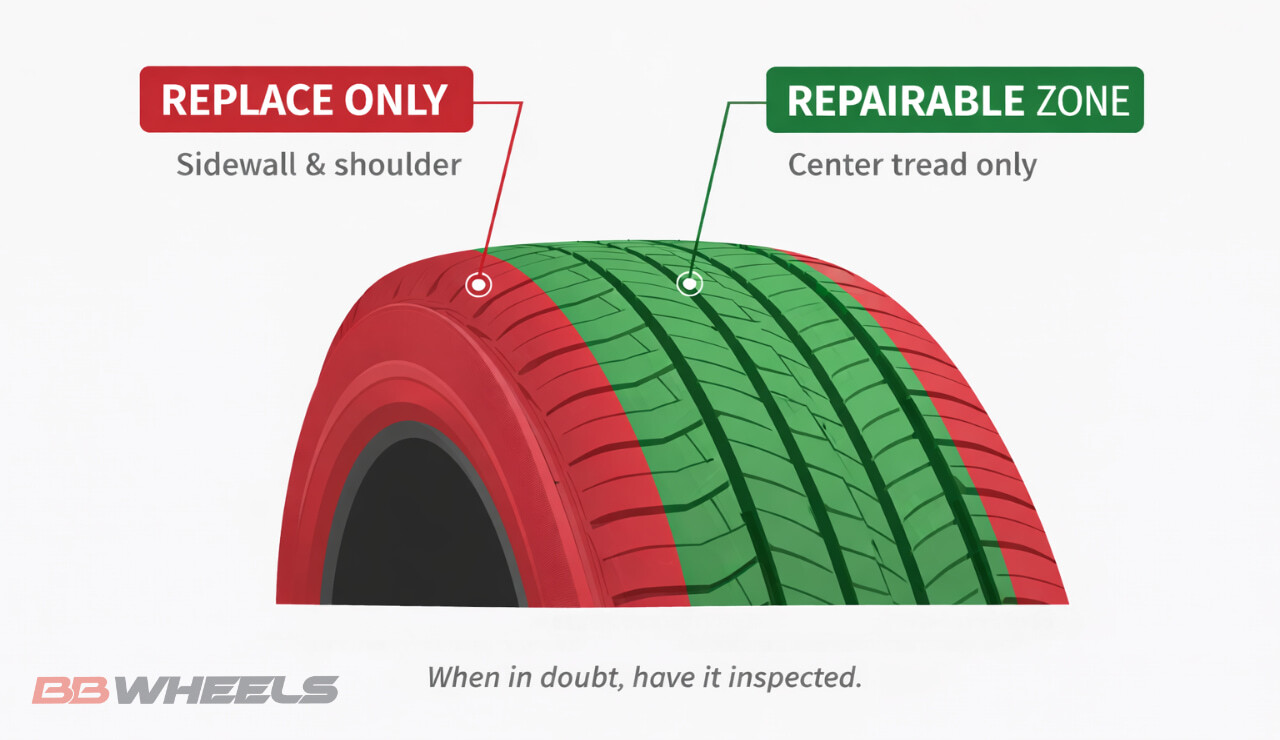
Tire diagram showing the safe tread repair zone and the replace-only shoulder and sidewall areas.
In general:
- Center tread area: Often repairable
- Shoulder area (outer tread edge): Usually replace
- Sidewall: Replace
This is because the tread center is thick and stable, while the shoulder and sidewall flex constantly under load.
Tire plug: quick fix, limited use
A tire plug is inserted from the outside of the tire and seals the puncture channel. Plugs are commonly used as:
- A temporary repair
- An emergency roadside fix
Pros:
- Fast and inexpensive
- Can stop air loss quickly
Cons:
- Does not seal the inner liner
- Does not allow inspection of internal damage
- Not considered a permanent repair by most tire manufacturers
Bottom line: A plug alone is usually not the best long-term solution.
Tire patch: better, but still limited
A patch is applied from the inside of the tire after dismounting it. This allows the technician to inspect internal damage.
Pros:
- Seals the inner liner
- Allows inspection of the tire interior
Cons:
- Does not fully seal the puncture channel
- Still limited to tread-area punctures only
A patch is better than a plug alone, but it still isn’t the most robust repair method.
Plug + patch combo: the preferred repair
Many professional shops use a plug-patch combination, which seals both:
- the puncture channel (plug portion), and
- the inner liner (patch portion)
This is widely considered the preferred repair method when:
- The puncture is in the center tread area
- The hole is within acceptable size limits
- There is no internal structural damage
If a tire is repairable, this method offers the best balance of safety and longevity.
When replacement is the only safe option
No repair—plug, patch, or combo—is considered safe if:
- The puncture is in the sidewall
- The puncture is in the shoulder area
- The tire has exposed cords
- The tire has a bulge or bubble
- The puncture is too large or irregular
- The tire was driven on while severely underinflated
Rule of thumb: If the puncture isn’t clearly in the center tread, replacement is usually the safest move.
Can you drive on a repaired tire?
If a tire is properly repaired using a plug-patch combo in the tread area, it can often be driven safely for the remainder of its usable life.
However, repaired tires should:
- Be monitored for pressure loss
- Be rechecked periodically
- Never be used if vibration or air loss develops
FAQ
Is a tire plug safe?
A plug alone is usually considered temporary. For long-term safety, a plug-patch combination is preferred.
Can a nail near the edge of the tread be repaired?
Punctures near the shoulder are typically not repairable because that area flexes heavily under load.
Why won’t shops repair sidewall punctures?
The sidewall flexes constantly and supports the tire’s structure. Repairs in this area are prone to failure.
Does road hazard coverage apply to nails?
Coverage depends on the program and damage location. Some road hazard plans cover non-repairable punctures that require replacement.
Bottom line
A nail in your tire doesn’t always mean replacement—but it does require the right decision. Punctures in the center tread can often be safely repaired using a plug-patch combination. Damage in the shoulder or sidewall usually means replacement is the safest option.
Not sure if your tire can be repaired or needs to be replaced?
Call 320-333-2155 and our team can help you figure out the safest next step.