

How to Test for Tire Rubbing Before You Buy
Posted by BB Wheels on 16th Feb 2026
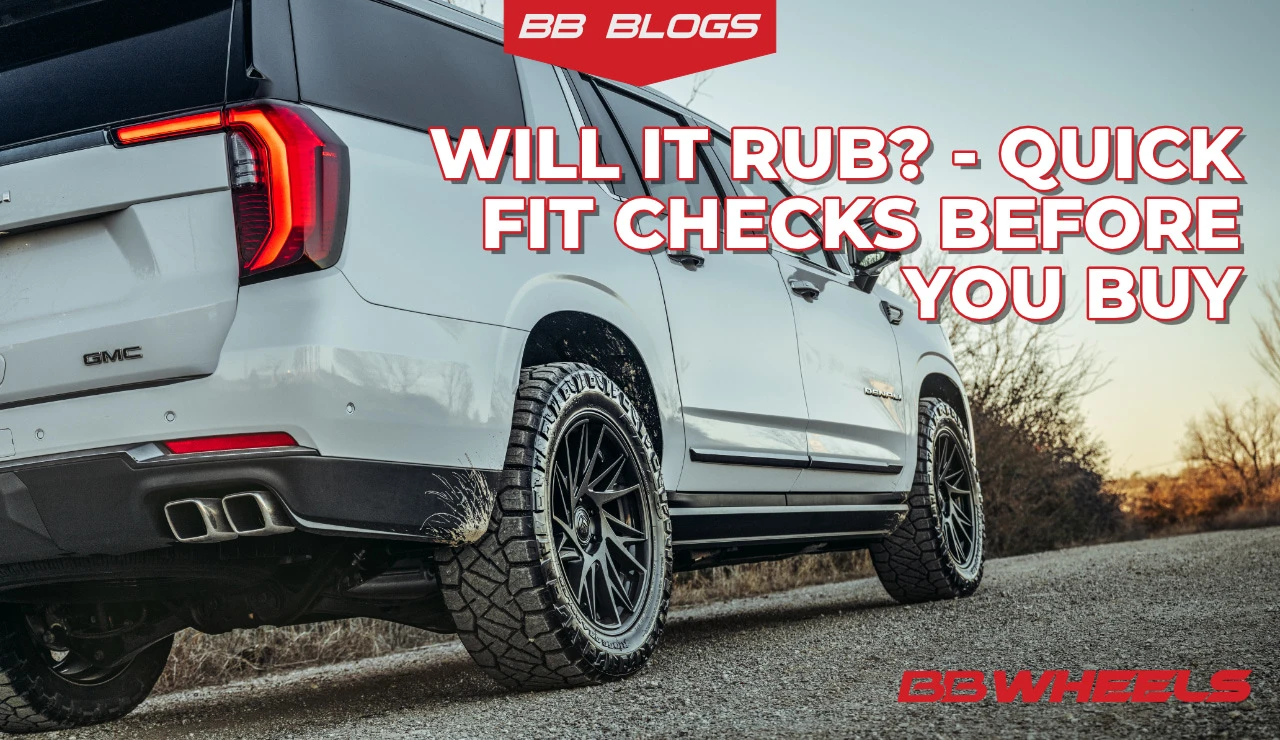
How to Test for Tire Rubbing Before You Buy
If you’re looking at a bigger tire size, the most common question is simple: will these tires rub? The tricky part is that rubbing doesn’t always show up sitting still in your driveway—it often happens at full lock, over bumps, or when the suspension compresses.
This guide is built to be straightforward. You’ll start by checking your vehicle (no math), then compare tire sizes, and finally factor in wheel changes like offset and width only if you’re buying wheels too.
Shop Tires & Wheels Get a Quick Fitment Check
Step 1: Do the quick clearance check on your vehicle (takes 3 minutes)
Before you think about tire numbers, check how close your current tires already are to rubbing. This is the fastest way to predict what will happen if you go bigger.
What you’re looking for: Any spot where your current tire is already very close to plastic, metal, or suspension parts—especially while turning.
A) Check at full lock (this targets “tire rub at full lock”)
- Park on flat ground.
- Turn the steering wheel all the way left and look inside the front wheel well.
- Turn all the way right and check again.
- Look for tight clearance in these common rub zones:
- Front/leading edge of the wheel well (bumper corner / valance / air dam area)
- Rear/trailing edge of the wheel well (liner near the body/cab — this is where front mud flaps commonly rub)
- Inside near suspension parts (control arm / sway bar area)
B) Do the “finger test” (simple and surprisingly accurate)
- If you can fit 2–3 fingers between the tire and the nearest liner/bumper at full lock, you have some room to work with.
- If you can barely fit 1 finger or it already touches, going bigger is more likely to rub.
Step 2: Compare your current tire size to the new tire size
For rubbing, you only need to compare two things:
- Height (overall diameter): Taller tires usually rub front-to-back in the wheel well when turning and hitting bumps.
- Width: Wider tires usually rub side-to-side (inside on suspension parts or outside on liners/bumper edges).
Quick tire size decode (only what matters)
Example tire size: 285/70R17
- 285 = tire width (wider)
- 70 = sidewall ratio (affects height)
- 17 = wheel diameter it fits (must match your wheel size)
Simple rule: If the new size is taller, rubbing risk goes up during turning + bumps. If the new size is wider, rubbing risk goes up on the inside/outside edges.
The easiest way to compare sizes (no guesswork)
Use the BB Wheels Tire Size Calculator to compare your current tire size vs your new tire size, then focus on:
- Overall diameter difference (taller vs shorter)
- Section width difference (wider vs narrower)
Tip: Two tires with the same labeled size can still measure slightly different depending on brand and model, so if you’re right on the edge, it’s smart to get a fitment check before ordering.
Step 3: If you’re buying new wheels too, factor in offset and wheel width
This is where people get surprised. You can choose a tire size that should fit—then change wheels and move the tire into a rub zone.
Offset (plain-English explanation)
- More poke outward (often lower or negative offset) = more likely to rub the outer liner/bumper/fender edge.
- More tucked inward (often higher positive offset) = more likely to rub inside on suspension parts.
Wheel width (why it matters)
- A wider wheel can change how the tire sits and where the sidewall bulge lands.
- That can make rubbing show up sooner even if the tire size is the same.
If you only remember one thing: Tire size tells you how big the tire is. Offset tells you where it sits.
Why some vehicles rub after a lift or leveling kit
It sounds backwards, but rubbing after a lift/level is common. Here’s the quick version:
- People usually add a lift/level because they want bigger tires (which increases rubbing risk).
- Alignment settings can change, and caster changes can move the tire closer to the back of the wheel well.
- Different wheels/offsets are often added at the same time, moving the tire outward or inward into a tight area.
Practical takeaway: If you lifted it and now it rubs, don’t assume the lift is “bad.” Most of the time, the fix is a combination of proper alignment and a tire/wheel setup that matches your available clearance.
How to interpret what you find (likely fits vs likely rubs)
- Likely fits: Your current setup has good clearance at full lock, and your new tires are only slightly taller/wider with no major wheel changes.
- Maybe (minor trimming/liner adjustment): Your current setup is close, or you’re stepping up noticeably in height/width, or your new wheels add more poke.
- Likely rubs: Your current setup is already tight and you’re going significantly taller/wider and/or changing to a more aggressive offset.
Common rub spots (where to look first)
- Mud flaps (very common)
- Front bumper/valance edge
- Rear portion of the front liner (closer to the cab/body)
- Inner liner near suspension
If it rubs: the easiest fixes (ranked)
- Remove/trim mud flaps (often the fastest fix)
- Minor liner adjustment (repositioning or slight trimming on plastic)
- Alignment check (especially after lift/level)
- Adjust tire choice (slightly narrower or slightly shorter can make a big difference)
- Re-think wheel offset (moves the tire away from the rub zone)
FAQ
Will these tires rub if I’m only going one size bigger?
Sometimes no, sometimes yes—it depends on how much clearance you have now and whether your new tires are going taller, wider, or both. The full-lock clearance check and the tire size comparison above are the best quick predictors.
Do bigger tires always rub at full lock?
Not always. Full-lock rubbing is most common when a tire is both turned and shifted into a tight wheel well area. Vehicles with tighter wheel wells, aggressive offsets, or larger diameter changes are the most likely to rub.
Why does my truck rub after a lift?
Usually because tire size and wheel offset change at the same time, and alignment settings shift after the lift. A proper alignment (especially caster adjustment when applicable) often reduces rubbing significantly.
Is rubbing on plastic a big deal?
Light rubbing on plastic liners can sometimes be addressed with minor adjustments. Hard rubbing on metal, suspension parts, or anything that affects steering and control should be corrected before driving.
Bottom line
If you want an easy way to predict rubbing before you buy, do this in order: check your current clearance at full lock, compare tire height and width, then factor in offset and wheel width if you’re changing wheels. Those three steps answer most “will these tires rub” questions without turning it into a complicated project.
Want us to double-check your setup before you order?
Call 320-333-2155 and we can help you estimate rubbing risk based on your vehicle, tire size, and wheel specs.